Monuments historiques covers, 1980–1985




Source: bibnum.mediatheque-patrimoine.culture.gouv.fr Caisse nationale des monuments historiques et des sites / Médiathèque du patrimoine et de la photographie, 8° PI 139. License: All Rights Reserved.
No. 107 (1980) featuring the Château de Chambord (photo by E. Revault). Design by Jean-Charles Rousseau.
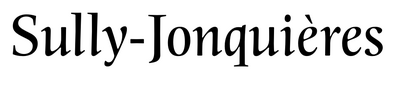
Eminent French type designer José Mendoza y Almeida was born on this day one hundred years ago, on 14 October 1926. We’ve featured Uses of several of his typeface designs before, including the serifless roman Pascal (Amsterdam, 1960), Photina (Monotype, 1971, designed as serif counterpart to Univers), and the eponymous ITC Mendoza (ITC, 1991). One of his typefaces we didn’t document in use yet is Sully-Jonquières.
Its design was inspired by publisher and bibliophile Henri Jonquières, who started his career as a graphic designer – in the 1930s, he worked together with Charles Peignot on Arts et Métiers Graphiques. For his books, Jonquières always longed to find the perfect typeface to complement the author’s text and the illustrator’s pictures, scouring printing shops in search of forgotten typefaces. He was fond of Garaldes, and of Garamond Italic in particular. Conscious of the limitations of italic type, he had long dreamt of something that had the same initimacy, but without the inclined posture. Jonquières was not a type designer himself. This is where José Mendoza came in, who started drawings for such an upright italic.
Henri Jonquières didn’t live to see the result: he passed away in 1975. His idea lived on, though. Mendoza was commissioned to design the logo for the Caisse Nationale des Monuments Historiques, France’s National Fund for Historical Monuments. When he was tasked to draw the masthead for the Fund’s journal, he continued work on the unfinished upright italic, and eventually developed a full typeface from it. It was published in 1980; by Socotep for phototypesetting and by Mecanorma for dry transfer lettering. The same year – dubbed the “Year of Cultural Heritage” – José Mendoza was awarded the Prix Maximilien Vox for the creation of Sully-Jonquières. The typeface’s name pays homage to the ideator and to the client – which is headquartered in the Hôtel de Sully in Paris.

Photo: Florian Hardwig. License: CC BY-NC-SA.
Glyph sets for both weights of Sully-Jonquières as shown by Mecanorma in the Graphic Book 14, 1988
Monuments historiques is the journal of Caisse Nationale des Monuments Historiques. Originally titled Les Monuments historiques de la France, it was published from 1936 to 1996 (with a hiatus between 1939 and 1955). The all-lowercase masthead in Sully-Jonquières appeared on the covers of 33 issues, from No. 107 (1980) to No. 139 (1985).
A main source for this post was the article “La naissance du Sully-Jonquières” by Henri de Montrond and René Ponot, published in Communication & Langages no. 47, 1980.

Source: bibnum.mediatheque-patrimoine.culture.gouv.fr Caisse nationale des monuments historiques et des sites / Médiathèque du patrimoine et de la photographie, 8° PI 139. License: All Rights Reserved.
No. 110 (1980), with a detail of the Marseille transporter bridge (Seeberger Collection, Spadem). Design by Jean-Charles Rousseau. The topics are set in caps from all-caps Franklin Gothic, with an ampersand that seesm to be taken from a bold italic Plantin.

Source: bibnum.mediatheque-patrimoine.culture.gouv.fr Caisse nationale des monuments historiques et des sites / Médiathèque du patrimoine et de la photographie, 8° PI 139. License: All Rights Reserved.
No. 116 (1981) with a detail from a depiction of Bacchus, Vienna Lapidary Museum (photo by E. Revault). Layout by Pierre Dusser.

Source: bibnum.mediatheque-patrimoine.culture.gouv.fr Caisse nationale des monuments historiques et des sites / Médiathèque du patrimoine et de la photographie, 8° PI 139. License: All Rights Reserved.
No. 118 (1981), featuring prehistoric paintings in the Pech-Merle cave (photo by R. Delon). Layout by Pierre Dusser.

Source: bibnum.mediatheque-patrimoine.culture.gouv.fr Caisse nationale des monuments historiques et des sites / Médiathèque du patrimoine et de la photographie, 8° PI 139. License: All Rights Reserved.
No. 134 (1984), featuring a Talbot Baby T23 from 1937, owned by Mr. Gilbert Vaccalut, Montlhéry (photo by E. Revault). Layout by Double File.
This post was originally published at Fonts In Use