Kaiser-Panorama at Mauthalle Nürnberg ad
Source: www.flickr.com Uploaded to Flickr by altpapiersammler and tagged with “blockpoppelbaum”. License: All Rights Reserved.




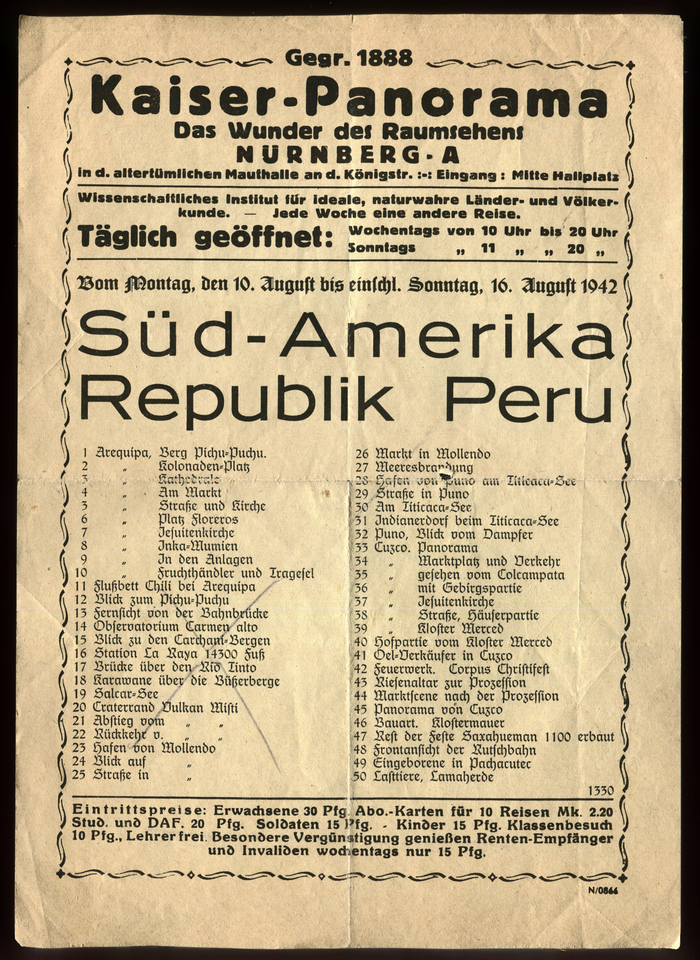
In August 1942, the Second World War was in full swing and Wehrmacht troops were approaching Stalingrad. At home in the German Empire – in Nuremberg, the city that previously hosted the Nazi Party rallies – the population was offered distraction and entertainment in the form of “true-to-nature geography and ethnology”.
Each week, the Kaiser-Panorama (est. 1888) in the Mauthalle presented a different virtual journey. This time, visitors could view stereoscopic glass slides depicting fifty three-dimensional scenes from the Republic of Peru in South America, from the Pichu-Puchu [sic!] to a herd of llamas. Students and DAF members paid a reduced entry fee; soldiers, children, seniors and disabled persons even less.
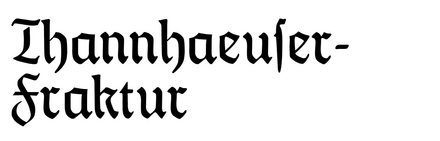
The typography of the leaflet combines blackletter and non-blackletter typefaces. There are two sans serifs, the bold rounded Block and the wide Industria, both from before the First World War. The price information at the bottom is set in an Art Nouveau roman that’s even older, Schelter-Antiqua halbfett from 1906. The two blackletter typefaces are the youngest designs: the dates are shown in Straßburg, released in 1926, and the list of scenes is set in Thannhaeuser-Fraktur, first cast in 1938.
This post was originally published at Fonts In Use