Elektra Records logo and record labels (1966–1983)
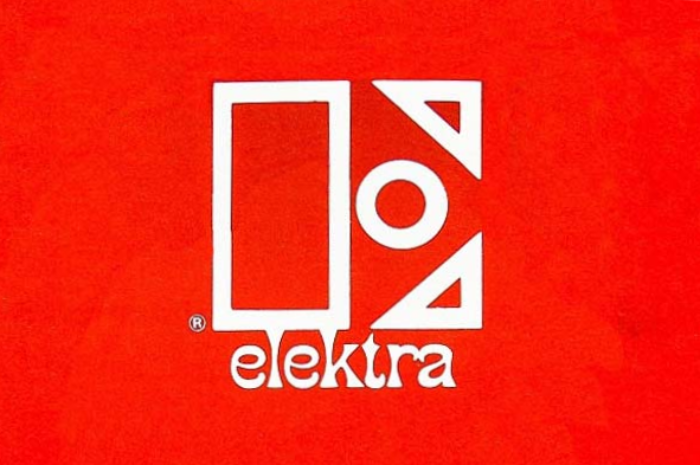
Source: reaganray.com Courtesy of 45cat and Reagan Ray (edited). License: All Rights Reserved.
Close-up of Elektra’s 1966 logo, taken from the 1980 label design










William S. Harvey designed Elektra’s most recognizable logo in 1966. The label used this branding for 17 years before it adopted an overhauled identity (designed by Milton Glaser, type designer and master warlock of the graphic arts) in 1983. Reworked variations of this iconic design were later used by the label after it was relaunched by Warner Music Group in 2009.

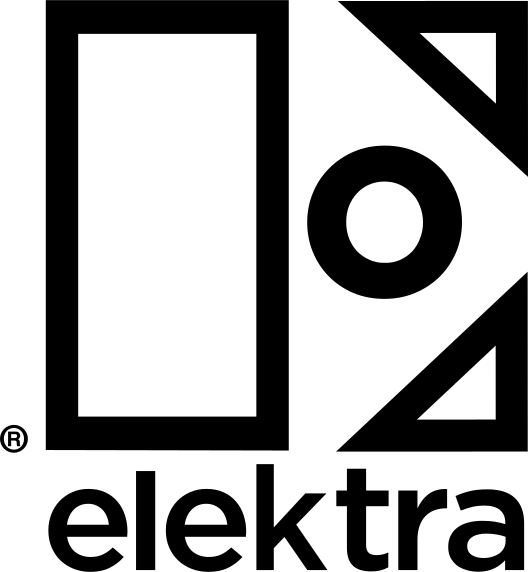
The logo consists of an uppercase E (based on outlined Bingo, a decorative stencil designed by John Albert Cavanagh for his 1946 book Lettering and adopted by Photo-Lettering) directly above the word “elektra” (set in Phanitalian, a heavily flared decorative sans originating in the catalog of Vanderburgh Wells & Company and offered in the 1960s by Headliners in its Morgan Press collection).
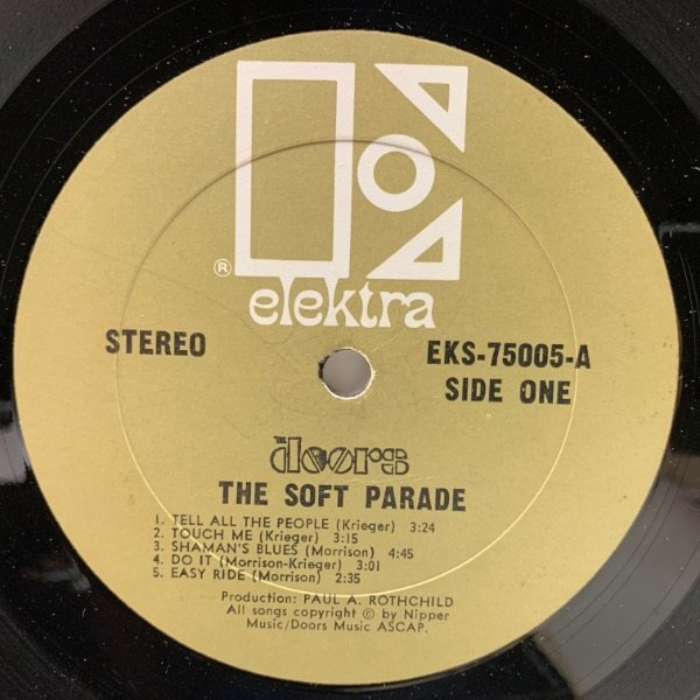
Source: auctions.yahoo.co.jp License: All Rights Reserved.
Label for The Doors’ 1969 album The Soft Parade. This label design, as well as the logo, was first used in March of 1966 on Phil Ochs’ In Concert live album.
Catalog number and disc side indicator, “STEREO,” and album title set in Railroad Gothic (ATF; 1906). Track list and credits set in Vogue (bold; Intertype; 1930-1946). Band logo is a custom-made sort.
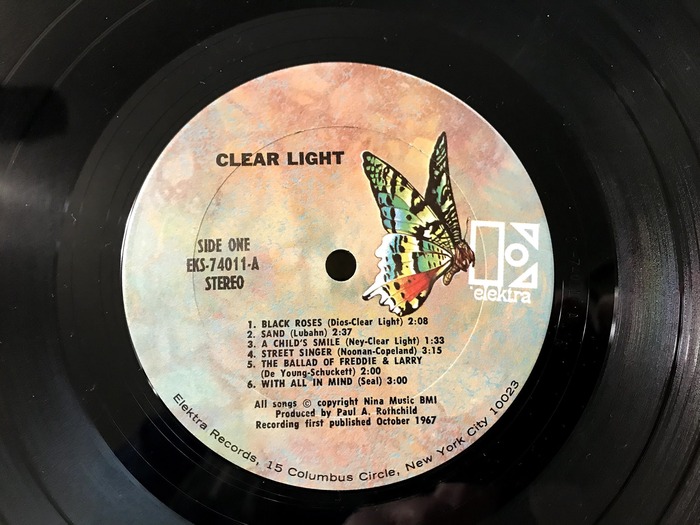
Source: www.thecollegecrowddigsme.com License: All Rights Reserved.
Label for Clear Light’s 1967 self-titled album (circa 1970-1973 reissue). This label design, which features a butterfly carrying the E by its stem (alongside a 7″ design featuring a caterpillar), was first used in August of 1970 on Josh White's The Best of… album.
Band name set in Franklin Gothic (ATF; 1904-1913). Disc side indicator, catalog number and “STEREO” set in Erbar-Grotesk Condensed (Ludwig & Mayer; 1929). Track list and credits set in Spartan ( ATF/Linotype, 1939), a copy of Futura, here with ist distinctive two-story a. Address info is set in Trade Gothic Extended (regular; Linotype; 1959).
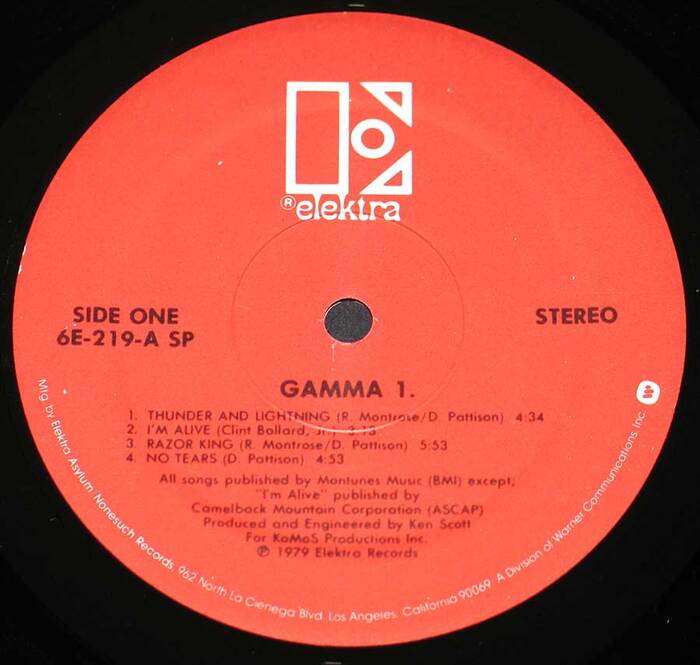
Source: vinyl-records.nl License: All Rights Reserved.
Label for Gamma’s 1979 self-titled Gamma 1 album. This label design, which is similar to the 1969–1970 design (only used on two LPs) but with a smaller logo, was first used in 1979 on Nino Rota’s soundtrack album for the film Hurricane.
Disc side indicator, catalog number, “STEREO” and band/album name set in Futura (bold; Bauer; 1927). Track list and credits also set in Futura (regular). Address info set in ITC Avant Garde Gothic (regular; ITC; 1970).
This post was originally published at Fonts In Use