Royal Hotel San Marco luggage label
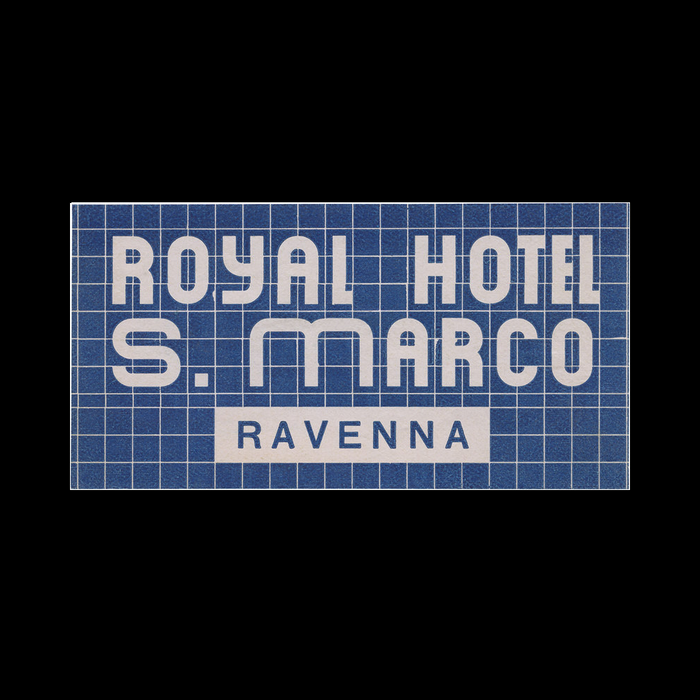
Source: www.flickr.com David Pearson. License: All Rights Reserved.

Ne-Po is a modular set of patterned blocks for building letters and other ornamentation, consisting of a negative (“Ne”) and a positive (“Po”) series. It was made in the early 1930s at Schriftguss AG vorm. Brüder Butter, a type foundry in Dresden, Germany. About a decade later, in 1944, American Type Founders issued a follower called Alpha-Blox. A photo taken by Indra Kupferschmid at Anonima Impressori documents that Ne-Po made its way to Italy, too, apparently via Schriftguss’s local agent, Giovanni Molteni in Bologna.
The luggage label shown above is from the collection of David Pearson. It measures 47mm×91mm and is undated. The Royal Hotel San Marco in Ravenna (50 miles from Bologna) was around at least since 1938. A postcard advertises the hotel as being the first in town to offer an elevator.
The unnamed designer composed the label with around 200 blocks of metal from the “Ne” series. The hotel’s name is shown in two lines, featuring a wide S and an extrawide M, to bring the second line to the same length as the first. Diagonals are avoided in favor of curved strokes, see R Y A and M. A small offset in the joints reveals the modular nature of the typography. This is best visible in the bottom third of some letterforms in the first line.
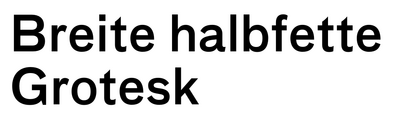
At the bottom of the label, a field of two by ten blocks was left blank, to accomodate the name of the town. It’s set in all-caps Breite halbfette Grotesk. Likewise originating in Germany, this design was available in Italy from Reggiani (as Alala) and by Nebiolo (as Grottescho nero and later as Etrusco nero).
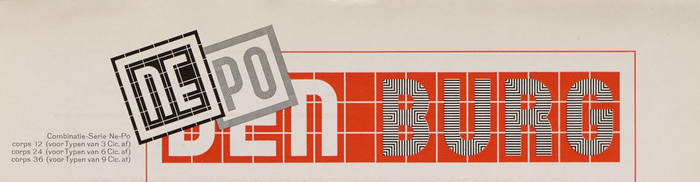
Source: oa.letterformarchive.org Photo courtesy of Letterform Archive. License: All Rights Reserved.
Detail with a showing of Ne-Po from a specimen for “modern printing type” by Schriftguss, issued in 1934 by P. van Dijk, the foundry’s agent for the Netherlands
This post was originally published at Fonts In Use