Repton 2 video game

Source: archive.org License: All Rights Reserved.
Inside back cover advert for Repton 2 from Superior Software.




Repton was a hugely successful and influential game on the BBC Micro, and spawned a host of sequels and knock-offs, including an open-world game with end-user created content. In a discussion of it in the book Acorn – A World in Pixels (in an article titled “The Making of Repton”) I find Chris Payne, marketing manager for Repton 2, to be one of us: he is quoted as saying “I used to sit in bed at night browsing through books of typefaces [...] and came across a newish typeface called Dave, so I asked Mike Ellis to use it for the strap line at the top of the Repton 2 advert.”
Interesting, as I had not heard of a typeface called Dave, so I went looking for the Repton materials. Time passes and it becomes hard to determine exactly which advert Chris Payne was referring to, but I note the Repton 2 advert in Micro User #36 does have a strapline... in a font i don’t recognise.
“Repton” is in the instantly recognisable Baby Teeth, which is also used for the earlier Repton, and the later Reptons. The 2 is in an airbrushed version of Quicksilver.
The Superior Software wordmark and “Acorn Electron / BBC Micro” are in ITC Bauhaus.
The body and much of the secondary text is set (tight-not-touching) in, well, I want to say ITC Avant Garde Gothic, and the £ sign very much wants me to say that, but the numeral 1 does not. An alternate from E+F?
Repton is the name of the character you play, and the average internet consensus seems to be that Repton is a lizard. Repton is also a village in Derbyshire and a school, but those are apparently unrelated.
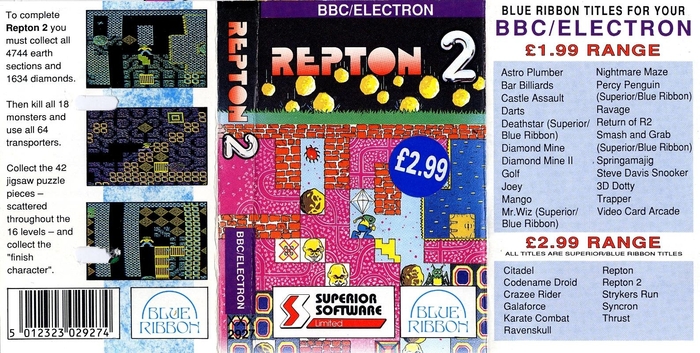
Source: www.acornelectron.co.uk License: All Rights Reserved.
The unfolded inlay (front) for the cassette version of Repton 2 (for the BBC Model B and Electron). Blue Ribbon (wordmark in Edda) was a budget label, publishing jointly with Superior Software. Because this is the budget release, this is likely a few years after the original 1985 release.
This post was originally published at Fonts In Use