Mondiacult 2025
José Hevia. License: All Rights Reserved.

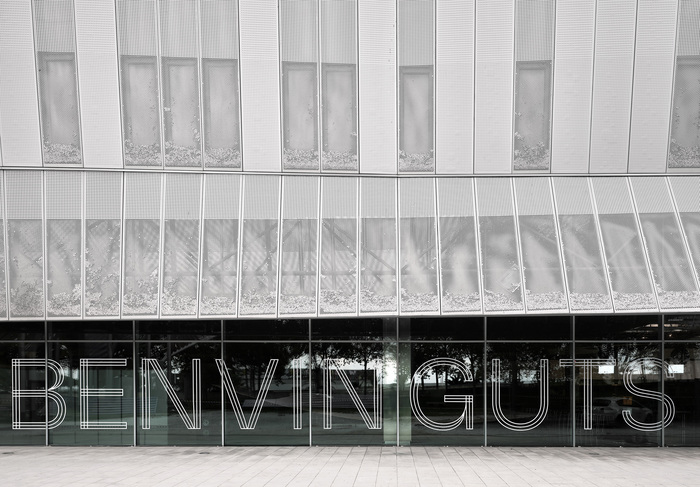
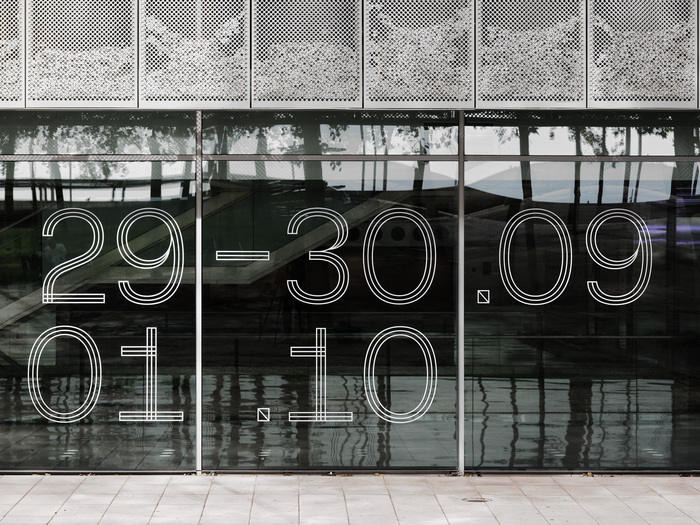
In September 2025, UNESCO and the Spanish Ministry of Culture held in Barcelona the third World Conference on Cultural Policies and Sustainable Development, known as Mondiacult – the largest global gathering devoted to cultural policy. Continuing UNESCO’s long-standing tradition of linking cultural diplomacy and architectural experimentation, the event commissioned a new spatial framework that transformed the corporate congress spaces of the International Convention Centre of Barcelona (CCIB).
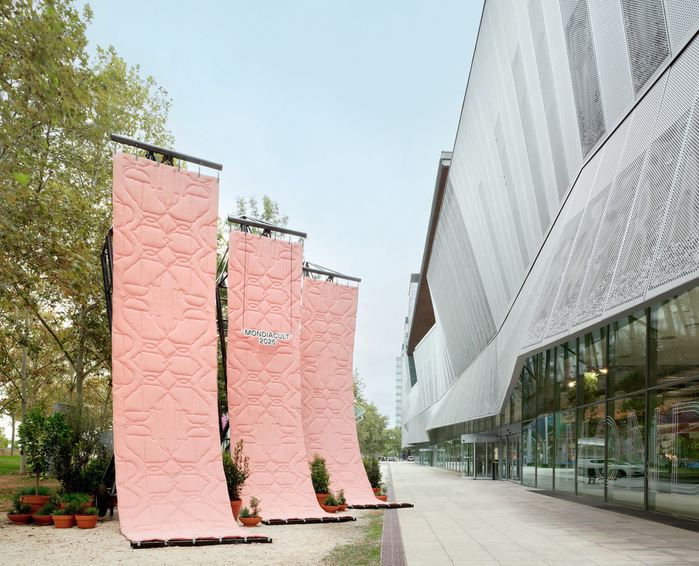
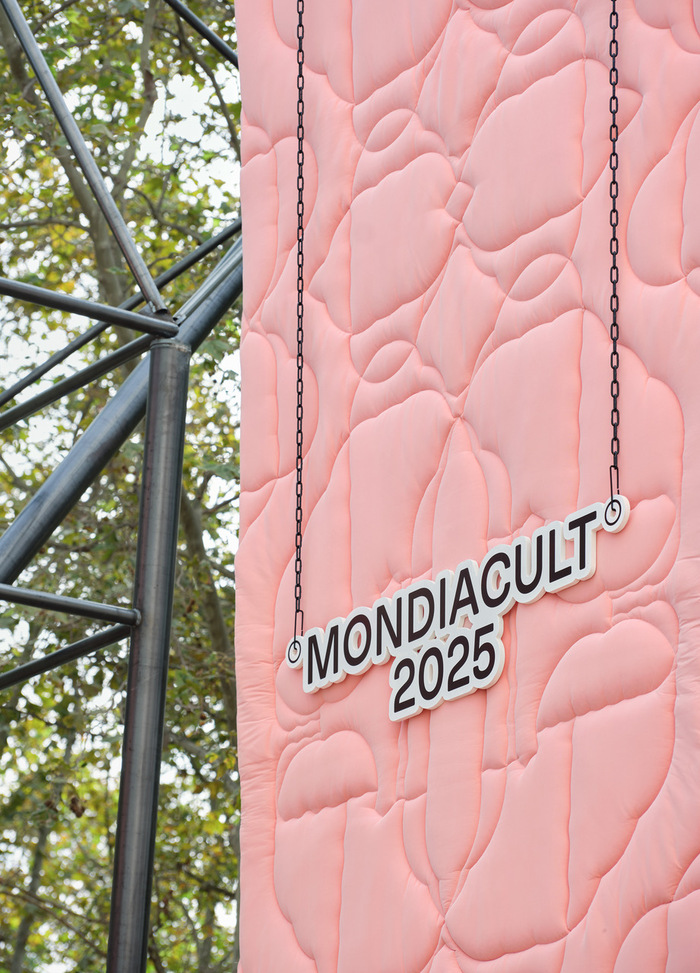
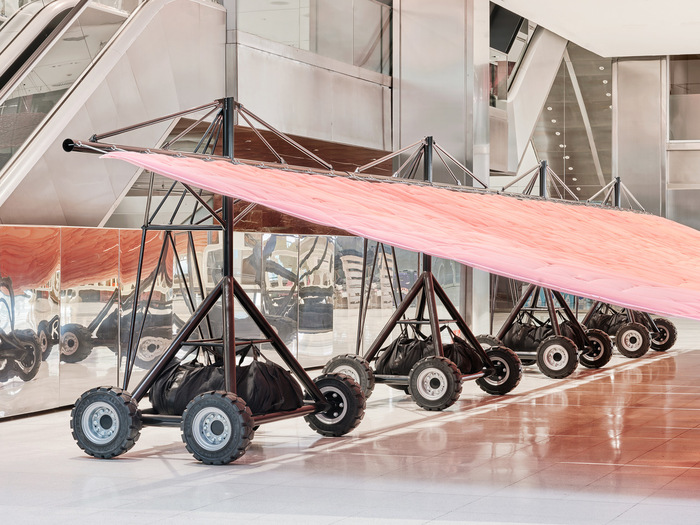
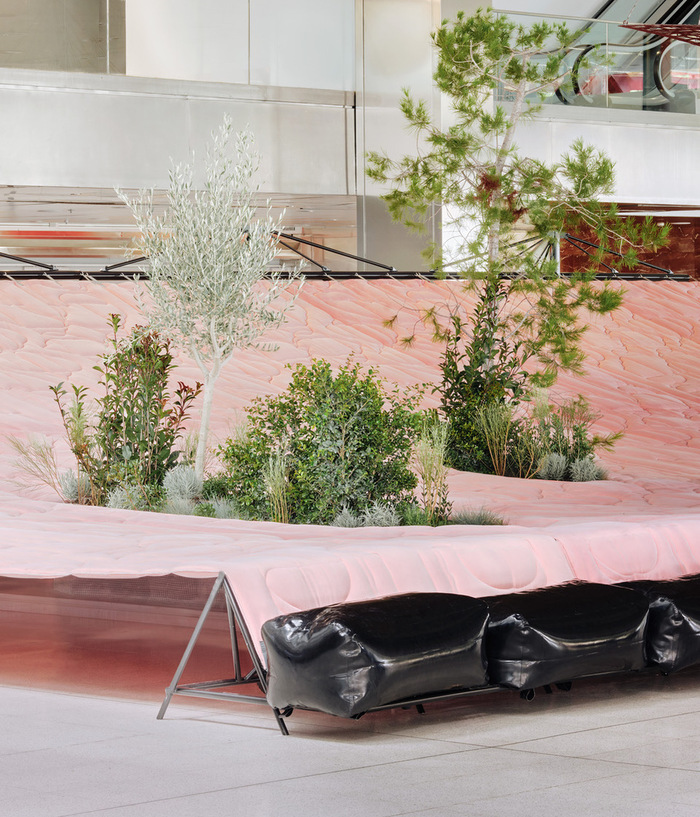
Held at a time when climate change and military conflicts increasingly endanger monuments and historic architecture, the spatial and graphic design of Mondiacult 2025 foregrounds the role of care in safeguarding heritage. Deployed throughout the CCIB, it affirms softness as a protective cultural value, countering the rigidity of institutional design. Large mattresses, recalling civilian anti-aircraft protections, envelop the building’s hall, punctuated by vegetal ecosystems that, in homage to Mediterranean conservation practices, create spaces for pause and retreat.
Throughout history, soft materials such as mattresses, textiles, and sandbags have been used to protect architecture from destruction. Their padded and sand-filled surfaces absorb blasts and fragmentation, a strategy adopted both by civilians and institutions. During the Second World War, civilians built sandbag walls around St. Paul’s Cathedral in London, while experts used seaweed mattresses and layers of sand to shield Giotto’s frescoes in Padua and the Camposanto Monumentale in Pisa. Decades later, similar gestures reappeared in Mostar, Kyiv, and Aleppo, where citizens covered bridges and monuments with flexible materials to prevent damage. These draped textiles mediate between fragility and resilience, extending acts of care from the intimate to the architectural scale.
Inside the building, mattresses span distances of ten to fourteen meters, while on the outside they hang from heights of up to nine meters, remaining exposed to the sea breeze and wind loads from the nearby coast. As their supporting structures cannot be anchored to the building’s floor or exterior surfaces, they are stabilized through a non-invasive double foundation system composed of heavy-load wheels and latex water bladders filled with phreatic water. In certain areas, these same bladders also serve as benches for attendees, their flexible surfaces adapting to the pressure and contours of the body.
Design team: Irene Domínguez, Sofía Marciel, Inés González Paradela, Nuria Fernández Herrera
Structure: Jorge López Hidalgo, Vian Studio
Contractor: Central de Projectes, Metada, Eix Jardiner, Igetex, GWC.
Client: Ministerio de Cultura, Gobierno de España, UNESCO
Surface: 3,000 m²
José Hevia. License: All Rights Reserved.
José Hevia. License: All Rights Reserved.
José Hevia. License: All Rights Reserved.
José Hevia. License: All Rights Reserved.
José Hevia. License: All Rights Reserved.
José Hevia. License: All Rights Reserved.
This post was originally published at Fonts In Use