Fluid Concepts and Creative Analogies by Douglas Hofstadter
Source: www.rarebookcellar.com Rare Book Cellar (edited). License: All Rights Reserved.



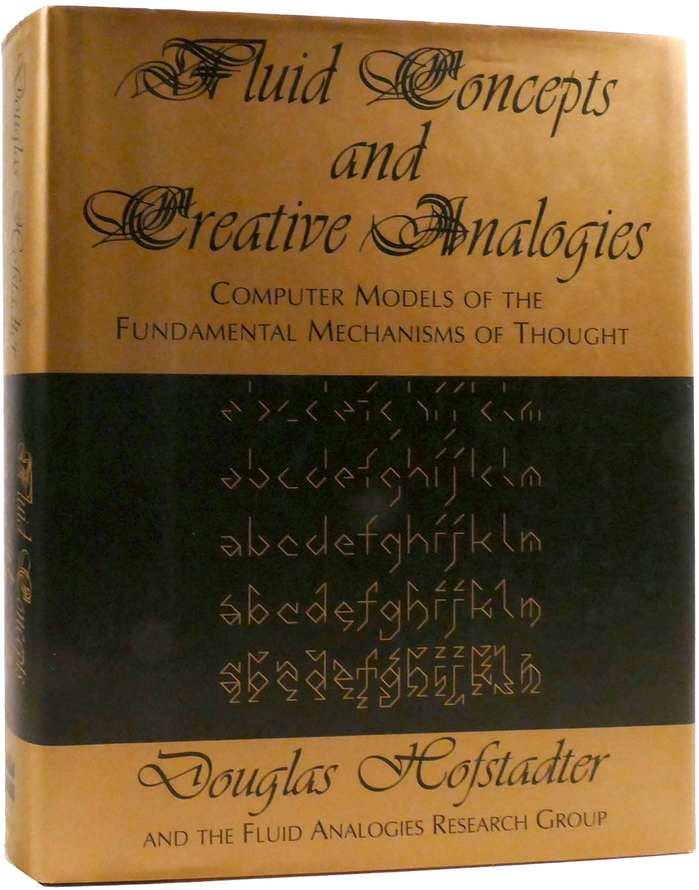
Fluid Concepts and Creative Analogies. Computer Models of the Fundamental Mechanisms of Thought was published by Basic Books in 1995. In the book,
Douglas Hofstadter and other members of the Fluid Analogies Research Group [are] exploring the mechanisms of intelligence through computer modeling. It contends that the notions of analogy and fluidity are fundamental to explain how the human mind solves problems and to create computer programs that show intelligent behavior. It analyzes several computer programs that members of the group have created over the years to solve problems that require intelligence.
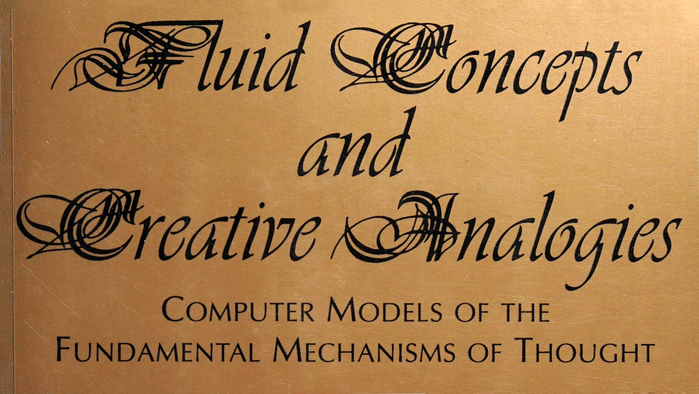
For the title, the unknown jacket designer brought together two script typefaces designed by Friedrich Peter, a German-born artist who emigrated to Vancouver in 1957. The lowercase characters are from Vivaldi, “the second Latin display typeface designed in Canada” [Canadian Typography Archives], released as one of 15 award winning type face designs in a competition sponsored by VGC in 1966. The capitals are from the exuberantly ornate Magnificat, also a winner in a type design competition, this time in one that was held by Letraset in 1973. The subtitle is set in Hermann Zapf’s Optima, unfortunately with faux small caps.
The illustration is taken from the Letter Spirit project:
The aim is to model how the 26 lowercase letters of the roman alphabet can be rendered in many different but internally coherent styles. The program addresses two important aspects of letterforms: the categorical sameness possessed by letters belonging to a given category (e.g., ‘a’) and the stylistic sameness possessed by letters belonging to a given style (e.g., Helvetica). Starting with one or more seed letters representing the beginnings of a style, the program will attempt to create the rest of the alphabet in such a way that all 26 letters share that same style, or spirit.
For the friends of some trivia: a copy of Fluid Concepts and Creative Analogies was the first book ever sold by Amazon.com.
Source: archive.org Internet Archive. License: All Rights Reserved.
Detail
This post was originally published at Fonts In Use