Amazônia. Indigenous Worlds / Indigene Welten
License: All Rights Reserved.


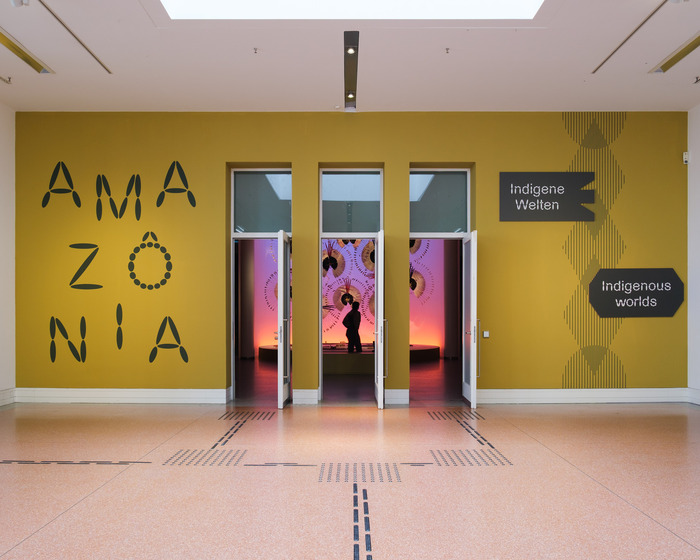
Instead of portraying the Amazon as a natural space, the Amazônia exhibition in Bundeskunstalle in Bonn presents it as a cultural space, a place where human and more-than-human inhabitants, diverse environments, tradition and modernity, as well as the most varied local and global political issues, converge and intertwine.
Made almost entirely of cardboard elements and other paper-based materials, the spatial design by the Bundeskunstalle’s in-house architect Hossein Maghsoudi converts the exhibition space from a white cube to an intricate web of routes and spaces.
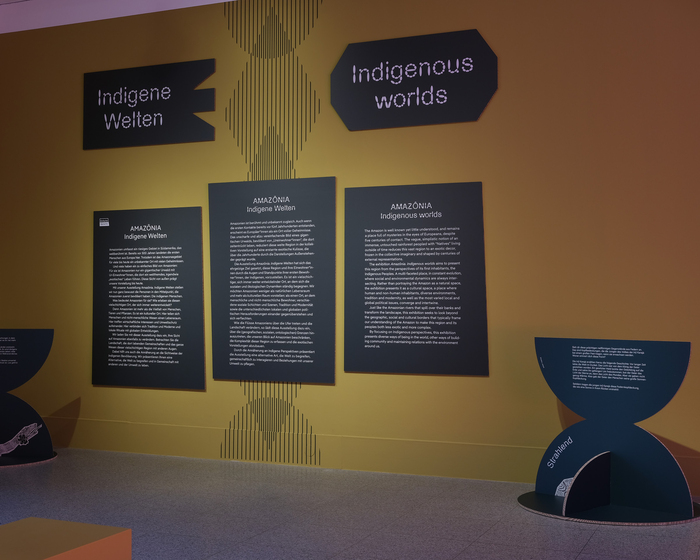
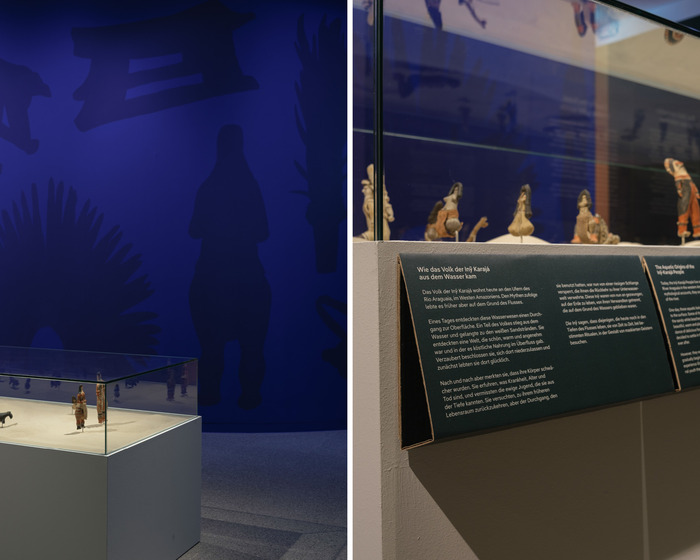
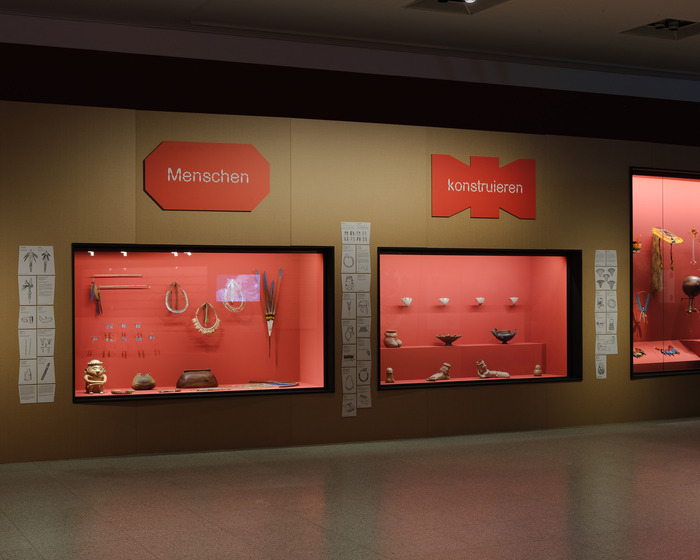
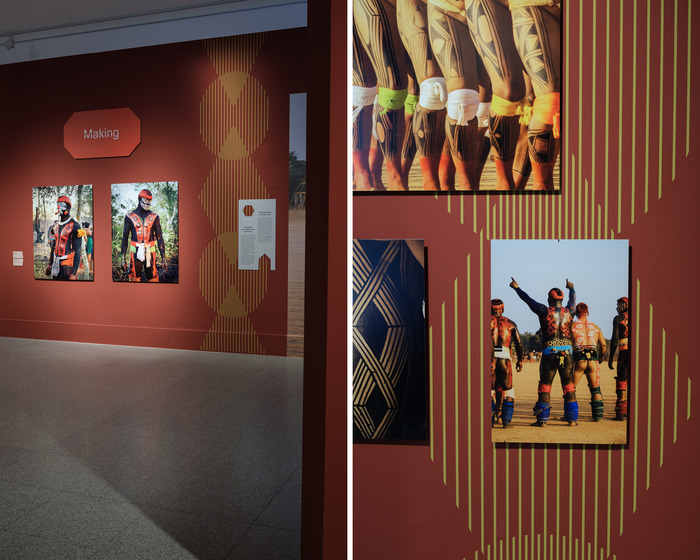
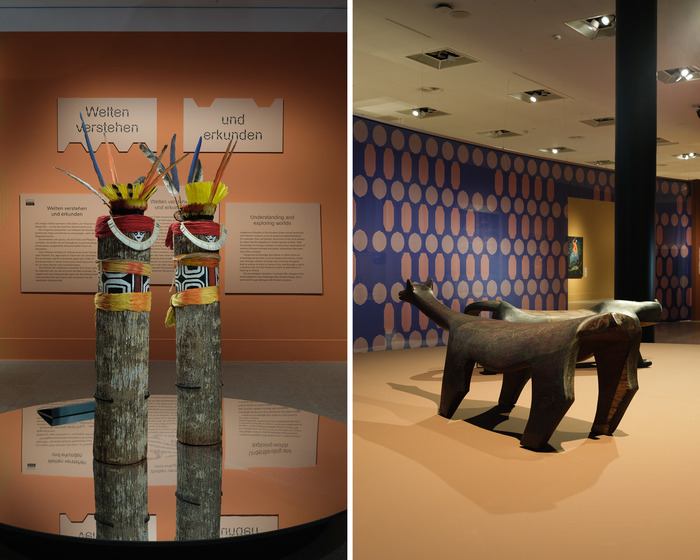
The exhibition design by Apsara Flury and her team responds to this purpose-built space with a multi-layered design system consisting of a custom wall colour palette, pattern-based room-dividing curtains and wall illustrations, and signage and object labels across various scales and functions. Room titles are set in Cerial by Theetat Thunkijjanukij. Body copy is set in Pangea Text by Christoph Koeberlin of Fontwerk, which explicitly includes First Nations IPA characters.
The signs featuring room titles and object labels are printed on reboard and dispa panels of varying thickness (the larger, the thicker). As they are mounted on the walls, the bulk of the material breaks through the smoothness of the underlying wall panels. When positioned on flat surfaces and alongside low vitrines, the labels are folded into triangular objects, allowing visitors to inspect the labels at a more comfortable angle. In some places, the panels expand into three-dimensional space in the form of free-standing objects made of interlocking reboard pieces.
Overall, the exhibition design seeks to break through conventional stereotypes that tend to represent Indigenous artworks either as part of ethnographic collections in European metropoles dating back to colonial times or in minimalist arts settings by creating an inviting and colourful setting where old and new artworks are displayed side-by-side.
License: All Rights Reserved.
License: All Rights Reserved.
License: All Rights Reserved.
License: All Rights Reserved.
License: All Rights Reserved.
This post was originally published at Fonts In Use