Teo Moussev & Bulgarian National Radio Symphony Orchestra – Gershwin: Cuban Overture, Concerto in F for Piano and Orchestra album art



Source: www.ebay.com Classical LPs (edited). License: All Rights Reserved.
Album cover [More info on Discogs]
In 1977, Balkanton, Bulgaria’s state-owned record company, released an album with compositions by George Gershwin, performed by pianist Teodor Moussev and the Bulgarian National Radio Symphony Orchestra under conductor Alexander Vladigerov.
The composer’s name is shown in inclined caps from an extrabold slab serif. It’s not set in a typeface. Instead, the letterforms were reproduced from an alphabet sample.
In her book Schrift und Schreiben (Leipzig, 1972), Hildegard Korger showed an “alphabet in the style of an italic Egyptienne” and two sets of decorative capitals derived from it – one with highlights and one with open letterforms – credited to Volker Küster, 1966. According to Günther Flake’s biography of Küster, Black Bull is the title of a design for an Egyptienne typeface in three styles, drawn as part of his diploma project at HGB Leipzig in the mid-1960s. Korger doesn’t mention the name “Black Bull”, but I have to assume that the samples in her book show Küster’s graduation project.

License: All Rights Reserved.
Composite image showing the “alphabet in the style of an italic Egyptienne” (top row) and two sets of decorative capitals derived from it (bottom row) by Volker Küster, 1966, from Hildegard Korger’s Schrift und Schreiben, VEB Fachbuchverlag Leipzig, 1972 (5th edition: 1982)

Scans: Artemiy Lebedev. License: All Rights Reserved.
Details from two Cyrillic adaptations of Küster’s all-caps highlight style, reproduced in Шрифт from 1975 (top) and Декоративные шрифты from 1987 (bottom). The latter is credited to Oleh Snarsky.
Black Bull was not produced as a proper typeface. It still got around, as Korger’s book was distributed abroad, including to “socialist brother countries” of the GDR, like Bulgaria and the USSR, where it inspired local designers. I’m aware of two Cyrillic adaptations of the all-caps highlight style that were reproduced in Soviet books, in Шрифт (Leningrad, 1975) and in Декоративные шрифты (Minsk, 1987). The latter is credited to Oleh Snarsky, a Ukrainian lettering artist who drew numerous alphabets for lettering manuals and alphabet source books, including original designs and Cyrillic adaptations of existing ones. Snarsky had previously shown sample words based on Küster’s alphabet in his book Шрифты/Алфавиты для рекламных и декоративно-оформительских работ (Kyiv, 1979).
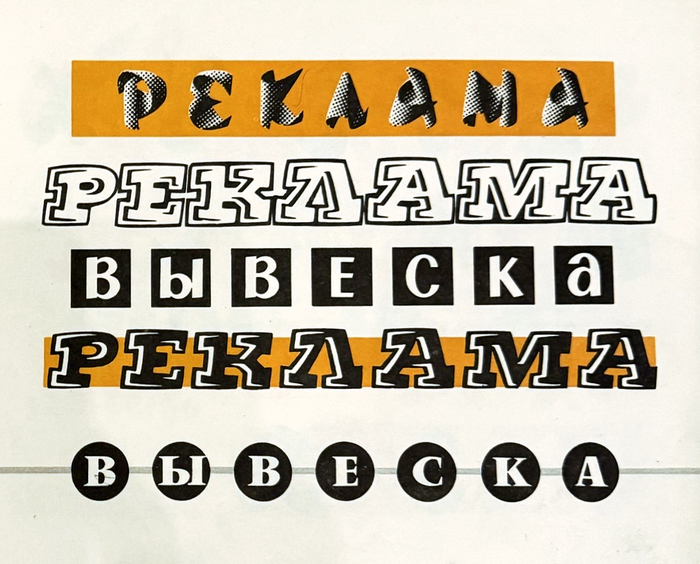
Source: www.olx.ua Klq (edited). License: All Rights Reserved.
“РЕКЛАМА ВЫВЕСКА” – page 31 from Шрифты/Алфавиты для рекламных и декоративно-оформительских работ (“Typefaces/Alphabets for advertising and decorative design works”), Kyiv, second revised edition, 1979. Snarsky shows a Cyrillic version of Black Bull’s highlight style plus an original reversed variant. The lines at the top and bottom are based on Roger Excoffon’s Calypso and Vendôme. The boxed glyphs in the center are either from an unidentified source or represent an original design by Snarsky.
The record cover features both Latin and Cyrillic letters based on Black Bull. Did the uncredited cover designer copy them from Korger’s book and invent matching Cyrillic themselves? Or did they get the inspiration from one of the Soviet books, and reverse-engineer the Latin? Chances are it was the former: the У in “ГЕРШУИН” matches Küster’s original Latin Y, while both Soviet adaptations feature different, asymmetrical glyphs.

Source: www.deezer.com License: All Rights Reserved.
Cover detail: the letters were applied individually – at least that’s what the unruly baseline and the disregard for the O’s overshoots suggest. Note that the first G has a thinner bar. Smaller text is set in a Cyrillic version of Futura.
Inevitably, Black Bull was made into a font eventually, at least in parts. Digital interpretations of the all-caps highlight style include Brad O. Nelson’s freebie Thats Super (Brain Eaters Font Co., 2001) and Brocken (RMU, 2011). To my knowledge, neither is authorized by the original designer.
Volker Küster died on 15 November 2025 in Kleve, at the age of 84. Born in 1941 in Wernigerode, Küster trained as typesetter and studied in Berlin-Schöneweide and subsequently at the Leipzig Academy. There he became the assistant of Albert Kapr and started teaching himself. He worked for the Typoart foundry and made himself a name as an award-winning book designer. In 1984, he left the GDR for West Germany. Küster started working for Scangraphic in Hamburg, where he headed the type design studio and served in the role of Type Director from 1985 to 1989. His Today Sans, a groundbreaking humanist sans serif, was released in 1988. After many years of teaching, initially in Hamburg and then in Essen, he devoted himself to free artistic work including iron casting.
Natascha Dell posted an obituary (in German) on the website of the Folkwang University of Arts in Essen. It includes quotes by former students Stephan Fiedler and Karsten Luecke, praising Küster’s merits as an educator. Albert-Jan Pool – who started his career as Küster’s assistant at Scangraphic – shared memories including images on Instagram, LinkedIn, and Facebook.
This post was originally published at Fonts In Use