Ferenczy Museum Center
Source: www.behance.net Agnes Herr. License: All Rights Reserved.

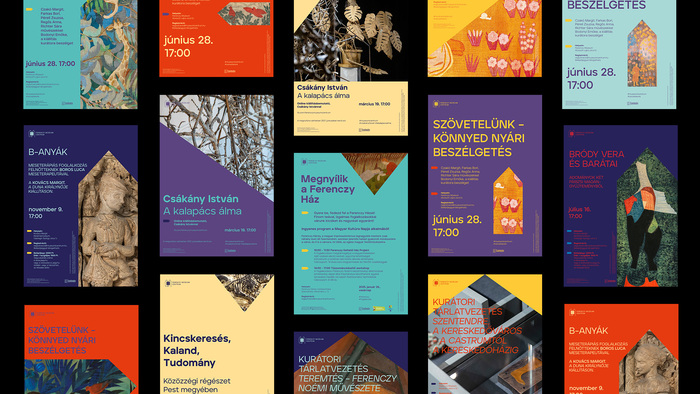
In the summer of 2020, the image of the Ferenczy Museum Center was rethought, building on the unique and characteristic motif world of Szentendre, placing special emphasis on local values. The unique architectural character that is still known today was formed as a result of the interaction of the exceptional stylistic features of the city’s Dalmatian, German, Hungarian and Serbian ethnicities, which spiced up the art of the artists there.
The activity of researching emblematic symbols is not unique, as it previously attracted artists to the city, such as Dezső Korniss and Lajos Vajda, who laid the foundations of modern Hungarian art. Following in the footsteps of Béla Bartók and Zoltán Kodály, the two defining artists began to explore the formal peculiarities of the houses, signs and everyday objects in the region, mainly in Szentendre and Szigetmonostor, and document them in their own style. The immortalized motifs do not necessarily correspond to the traditional ethnographic definition, as they immortalized countless elementary objects that are primarily formally exciting for an artist.
Summarizing their research activities based on folk traditions, they recognized that Hungary, in terms of geographical and cultural influences and due to its special location, forms a symbolic bridge between the West and the East. Vajda and Korniss, who call themselves bridge builders, started from this insight and created the “Szentendre program”, which was intended to do no less than give birth to modern Hungarian art.
In developing the visual foundations, how and where we positioned ourselves in the museum sphere played a very important role, since Szentendre is a city with a 110-year-old artistic tradition, where both 20th century and contemporary artists play a prominent role. It was important to explore what values we represent and what is the cause we are carrying forward.
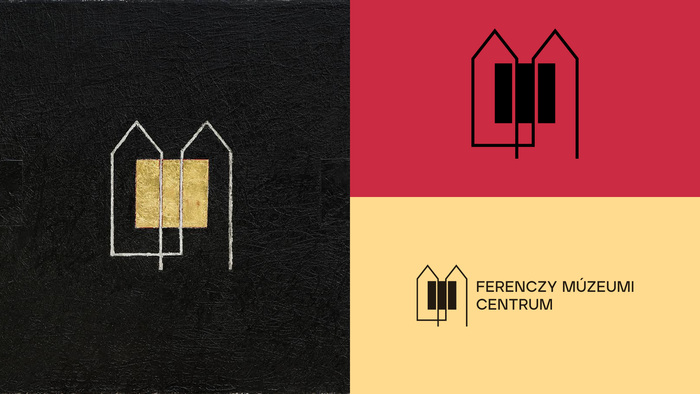
The spirit of the bridge builders is represented by many artists who still work here today. Building on the traditions, I continued to search for an appearance that is deeply rooted in the ideas and traditions described by the bridge builders. After many solutions, the emblematic sign depicting a cathedral in Péter Bereznai’s 2015 work entitled In the Middle of Darkness embodied the ideal that is most characteristic of the museum’s mission.
Every brand has a perceptible and an imperceptible part. The imperceptible part includes how the institution communicates, what its PR and marketing activities are like. The imperceptible part includes the image elements and their visual appearances. The most important visual element is the logo.
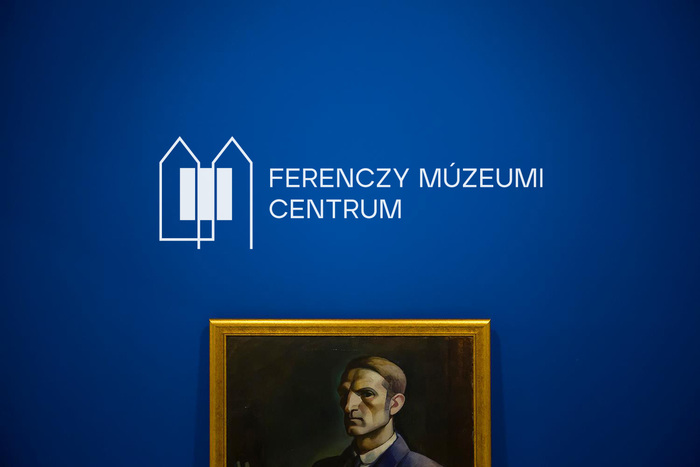
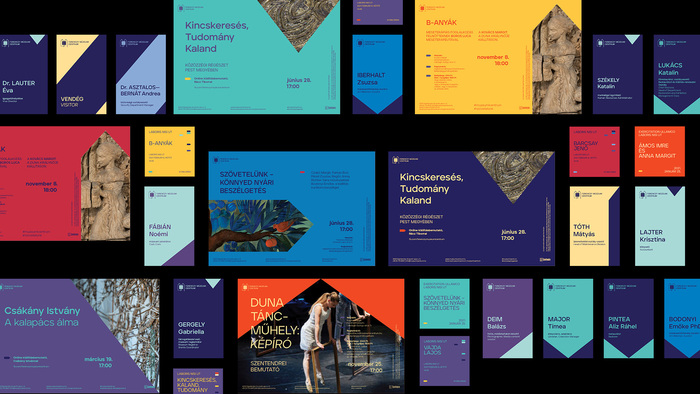
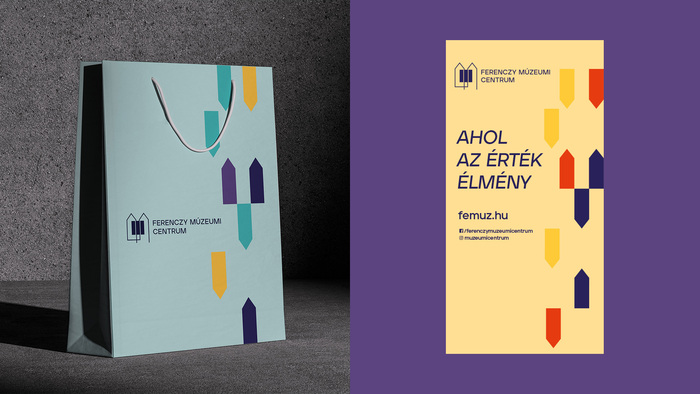
After stylizing the selected motif and standardizing the typography, the currently used emblem was finalized. The most important visual element of the image is the logo, and the unique visual design language is built around it, which makes the institution easily identifiable. Additional tools of visual language are the shapes, colors, typography, and imagery that originate from the logo. Their unique design and the impact of their appearance are what makes the institution identifiable.
See more images on Behance.
Source: www.behance.net Agnes Herr. License: All Rights Reserved.

Source: www.behance.net Agnes Herr. License: All Rights Reserved.
Source: www.behance.net Agnes Herr. License: All Rights Reserved.
Source: www.behance.net Agnes Herr. License: All Rights Reserved.
Source: www.behance.net Agnes Herr. License: All Rights Reserved.
This post was originally published at Fonts In Use