The “Optimus” Press advertising cards
Richard Sheaff. License: All Rights Reserved.






The Cottrell & Babcock Manufacturing Company was founded in 1855 in Stonington, Connecticut. In 1880, Nathan Babcock purchased the shares of co-founder Calvert Cottrell and set up a new printing press manufactory together with his nephew George Fenner. Renamed the Babcock Printing Press Manufacturing Company, it was moved to New London. Around 1886, Babcock introduced the two-revolution “Optimus” press. From Steve Fithian’s 2024 article for Otis Library:
The Optimus became the new industry standard for the production of high quality printing. Harper & Bros. of New York used the Optimus exclusively to print their popular and influential periodicals, Harpers Weekly and Harper’s Monthly magazine. By 1899, the company’s strong commercial success allowed for the expansion of the employee base to 250 men occupying 180,000 square feet of factory floor. During the period between 1883 and 1919, the company sold over 7,000 printing presses to businesses in every state of the Union with a global market that included Canada, Mexico, Europe and parts of Asia.
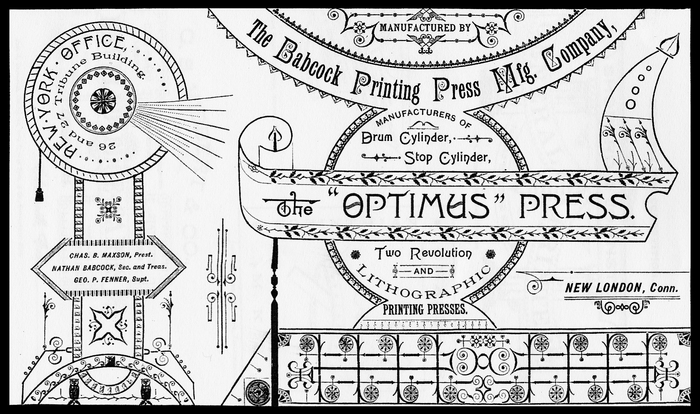
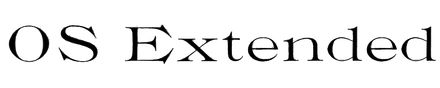
In their Handy Book of Artistic Printing from 2009, Doug Clouse and Angela Voulangas date the advertising card shown above to 1886. All the linework—including curves—were done up in brass rules, along with the metal type fleurons and dingbats. The main typefaces are Mother Hubbard (1885) for “‘Optimus’ Press” and “New York Office” and Latin Condensed (1873) with initials from Ideal (1884) for “The Babcock Printing Press Mfg. Company”. The then freshly introduced Art Gothic (1886) is used with caps from Mother Hubbard for “Drum Cylinder”, “Stop Cylinder” and “Two Revolution”. “Lithographic” and the New York address are set in Old Style Extended (by 1884). There are a couple of unidentified typefaces, including a gothic and an italic sans.
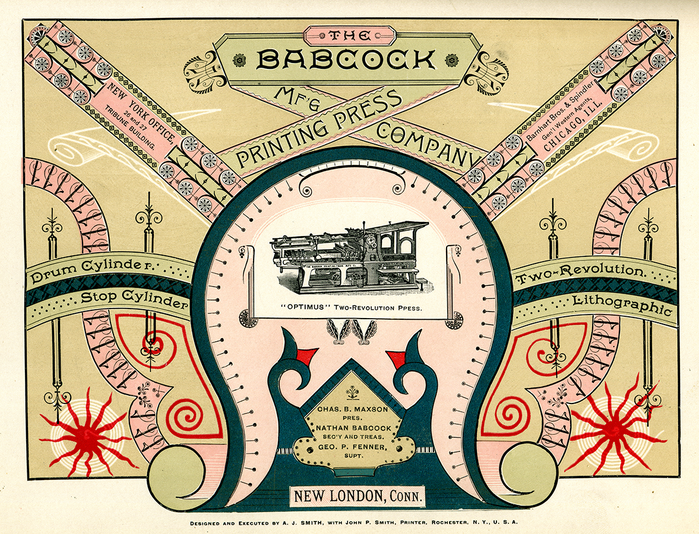
The colored card shown below followed in 1887. Its design also features Mother Hubbard. The wide typeface used for “Babcock” and, in mixed case, for “Drum Cylinder / Stop Cylinder / Two-Revolution / Lithographic” is Bowl, shown by Farmer the same year.
For both cards A.J. Smith was the compositor, with the printing firm of John P. Smith in Rochester, NY.
Collection of Stephen O. Saxe. License: All Rights Reserved.
This post was originally published at Fonts In Use